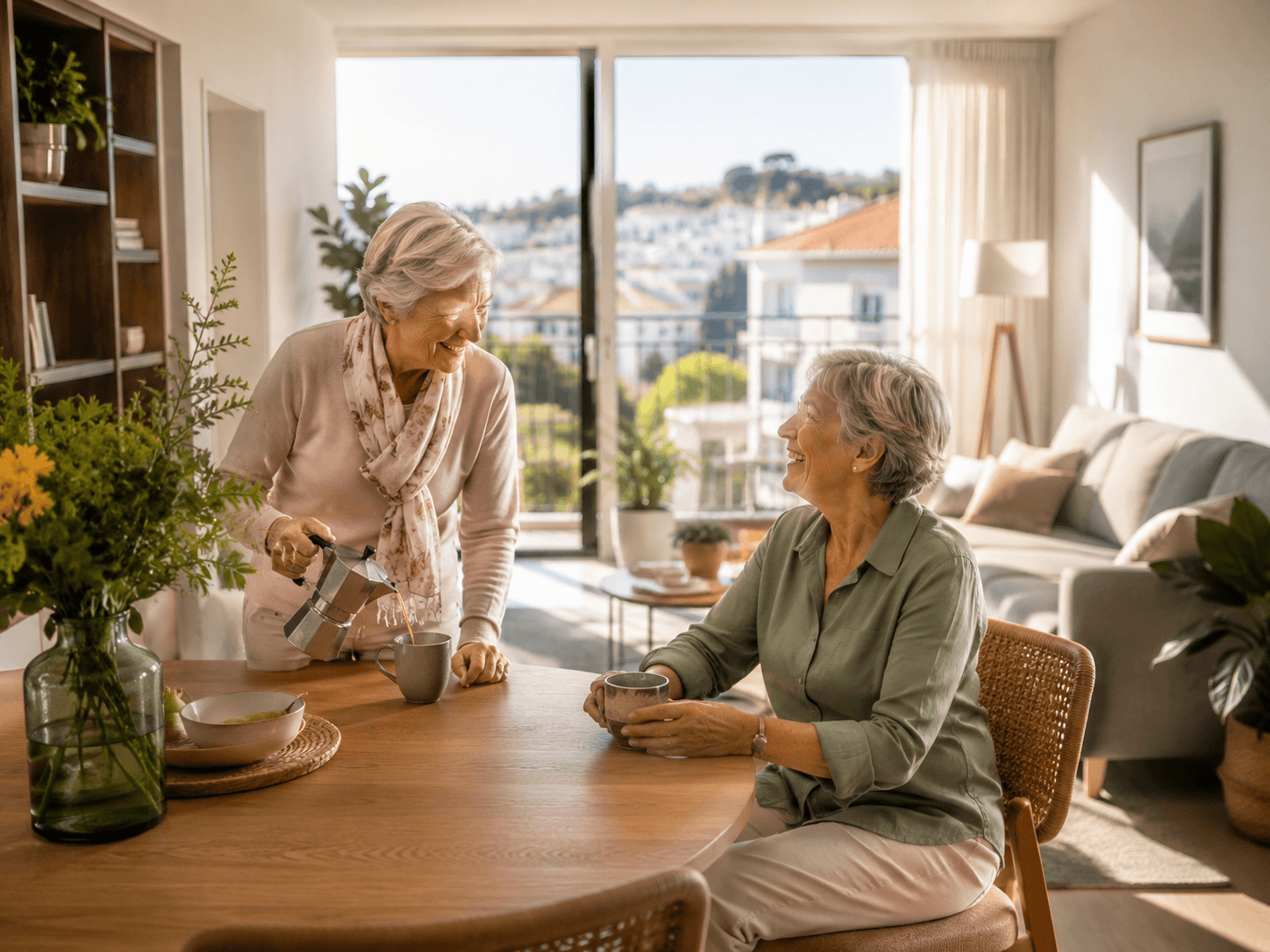
Senior living in Portugal: what it is, how it works and who it is for
Gradiente de imagem de fundo
Senior living is a housing concept designed to support a longer life with independence, privacy and greater ease in everyday life.
In the Senior Independent Living model, each person lives in their own apartment and can benefit from services, shared spaces and opportunities to socialise, while retaining the freedom to organise their life as they choose.
But not all senior living options are the same. Services, levels of support, types of accommodation and resident profiles vary between developments. Before comparing options, it is therefore important to understand exactly what each one offers and who it is designed for.
In this guide, you will discover:
what senior living is;
what independent living means;
how it works;
who it is suitable for;
how it differs from a care home or staying in your current home;
why it is becoming more relevant in Portugal;
what to consider before choosing.
What is senior living?
Senior living is an international term used for different housing options aimed at people in a later stage of life.
The concept can include models with very different levels of independence and support. For this reason, the term senior living, on its own, does not necessarily mean assisted living or a care home.
When we refer to Senior Independent Living (independent housing with services), we mean a solution designed for people who are independent, live in a private apartment and want to continue deciding how they organise their time, routines and everyday life.
The accommodation is complemented by services and shared spaces that can make managing the home easier, increase convenience and create more opportunities to socialise.
You may also come across terms such as active senior living, which places greater emphasis on an active lifestyle, or independent living, which focuses primarily on independence. More important than the label is understanding exactly who can live in these homes, what services are available and what level of support is provided.
How does Senior Independent Living work?
Senior Independent Living aims to combine two dimensions that are not always available in conventional housing: a genuinely private space and a range of services and shared areas available within the same residential setting.
Residents continue to have their own home. They do not share their apartment and remain free to decide when to go out, receive visitors, cook, take part in an activity or simply spend the day on their own.
What changes is the ability to simplify some everyday tasks and have certain services and spaces available without having to organise them individually.
Element
How it works
What to check
Apartment
Private, independent living space
Apartment types, floor areas, accessibility, equipment and features
Services
Some services may be included and others optional
What is included in the monthly fee and what is charged separately
Shared spaces
Areas for socialising, exercise, dining or other activities
Which spaces are available and whether their use is included
Community
Opportunities to take part in activities and meet people with similar interests
Frequency, variety and whether participation in the programme is optional
Safety and support
Solutions designed to provide greater peace of mind in everyday life
Systems in place, operating hours and procedures when support is needed
Location
Can support an independent life beyond the residence
Proximity to shops, public transport, culture, healthcare and green spaces
Costs
Usually a more integrated cost structure than managing a conventional home
Monthly fee, utilities, additional services and contractual terms
This combination is one of the main differences compared with a conventional home: it is not simply about choosing an apartment, but about assessing the home, services, location and lifestyle as a whole.
Who is senior living suitable for?
Senior Independent Living is particularly suitable for people who remain independent and want to preserve that independence, but are looking for a home better suited to their stage of life.
Motivations can vary greatly from person to person. For some, a large home has started to require too much time and maintenance. For others, what matters is living closer to the city, their children, friends or services they use regularly.
Some people also value simply having company nearby without giving up their privacy.
The decision does not therefore have to arise from a need for care. It can be a proactive choice: moving while you remain independent, able to make decisions and free to choose the option that best matches your own preferences.
The model may not be the most suitable option where there is a need for ongoing assistance, long-term care or regular clinical monitoring. In those cases, solutions specifically designed to provide that level of support should be considered.
Is senior living the same as a care home?
No. Senior Independent Living and a Residential Structure for Older People (Estrutura Residencial para Pessoas Idosas, ERPI) meet different needs.
Portuguese legislation defines an ERPI as a temporary or permanent collective accommodation establishment where social support activities are provided, together with care appropriate to the needs of residents and their families.
Senior Independent Living, by contrast, is a housing model centred on independent living: a private apartment, individual autonomy and services designed to make everyday life easier.
Neither model is, by definition, better than the other. The relevant question is which one matches each person's level of independence, needs and preferences.
Question
Staying in your current home
Senior Independent Living
ERPI / care home
Type of accommodation
Your own house or apartment
Private apartment within a development with services
Collective accommodation
Day-to-day independence
High, with individual management of the home
High, with integrated services available
Depends on each resident's needs
Service management
Arranged individually
Part is integrated into the residential solution
Social support and care are part of the provision
Community life
Depends on personal network and neighbourhood
Shared spaces and opportunities to socialise within the development
Collective residential environment
Most suitable when…
The home remains suitable and easy to manage
The person is independent and looking for simplicity, privacy and community
There is a need for a solution with appropriate support and care
This distinction is particularly important because terms such as “senior residence” are used very broadly. When comparing options, do not assume the model based on its name alone: always check the type of accommodation, resident profile and services actually provided.
Why is senior living becoming more relevant in Portugal?
Demographic change is one of the factors making this discussion increasingly relevant. In 2024, 24.3% of the Portuguese population was aged 65 or over, according to data from Statistics Portugal (INE).
But living longer raises a question that goes beyond age: how do we want to live those years?
The home we live in at 40 or 50 may remain perfectly suitable later in life. But it may also become too large, require constant maintenance, be far from the routines we value or make a simpler life more difficult.
It is in this context that alternatives are beginning to gain ground between two extremes that are often presented as the only choices: staying in the same home for ever or moving to a residential setting focused on care.
Senior Independent Living introduces a third possibility: moving to a home designed to support independent living, with services and community close at hand.
Stay in your current home or move to an apartment with services?
There is no one-size-fits-all answer.
Staying in your current home may be the best option when the home remains suitable, the costs are sustainable, the location works well and managing it is not a concern.
Moving may make sense if you want to reduce day-to-day tasks, live in a more functional home, be closer to services or family, or bring together in one place things that currently have to be arranged separately.
The comparison should go beyond the monthly fee or rent. Maintenance, utilities, insurance, cleaning, travel, individually contracted services and the time spent managing the home are also part of the true cost of each option.
So, rather than asking “which option is cheaper?”, it may be more useful to ask: “which solution allows me to live the way I want, with costs I understand and can predict?”
What should you consider before choosing a senior living option?
Confirm who the development is intended for and what the eligibility criteria are;
Visit or carefully review the apartments and understand the level of privacy and independence they offer;
Distinguish between services that are included and those that are optional or charged separately;
Assess the location and what is within a comfortable distance for everyday life;
Understand how safety, support and emergency procedures work;
Understand every component of the monthly cost and the contractual terms;
Assess whether the shared spaces and programme of activities match your interests, without assuming that you will have to take part;
Ask what happens if your needs change in the future;
Compare the option with the actual cost and circumstances of staying in your current home;
Make the decision with enough time to compare alternatives and choose, rather than reacting only when an urgent need arises;
How does Club65 fit within this concept?
Club65 follows the Senior Independent Living model and was designed for people aged 65+ who remain independent and want to continue living independently.
Each resident has their own apartment and organises daily life according to their own choices. Services are there to simplify certain tasks, while shared spaces offer opportunities to take part in activities, socialise or simply enjoy other areas whenever they choose.
An urban location is also part of the concept. The idea is not to create a life enclosed within a residence, but to maintain connections with the neighbourhood and city, including restaurants, shops, culture, gardens, services and the people who are part of everyday life.
Club65 is not an ERPI or a residential setting focused on the permanent provision of care. The starting point is independence: privacy when you want it, community when you choose it, and services when they are useful.
Frequently asked questions about senior living
Is senior living only for people who need help? No. Senior Independent Living is specifically intended for people who remain independent. Services are available to make everyday life easier and provide greater convenience, not to replace decision-making or impose a routine.
Do “senior living” and “senior residence” mean the same thing? Not necessarily. “Senior residence” is a broad term and can be used for very different models. It is important to understand whether there is a private apartment, who the development is intended for, what services are provided and whether the model is focused on independence or on assistance and care.
What is the difference between independent living and assisted living? The independent living model is designed for people who can live independently, while still having access to services. The term assisted living is commonly used for models offering a higher level of support with activities of daily living. Terminology and regulatory frameworks vary between countries and operators, so you should always confirm exactly which services are available.
From what age can someone live in a senior living apartment? It depends on the conditions of each development. Operators may apply different age criteria. In the case of Club65, the concept was developed for people aged 65+ who remain independent.
How much does senior living cost? The cost depends on the location, apartment type, services included and each operator's pricing structure. A thorough comparison should separate the base monthly fee, optional services and other costs, and compare them with the actual expenses of the current home.
What happens if a person's needs increase over time? It depends on the model and the services available. This is something that should be clarified before making a decision. An Independent Living development should not be confused with a permanent care setting, so it is important to understand in advance the limits of the service and the options available if a resident's circumstances change.
Discover why more and more people are choosing to move house when they retire. Learn how to prepare for the move and enjoy this new phase of your life with greater freedom, security and quality of life.